When one prays, what should one ask for?
Should one ask for anything at all?
Its an interesting question that popped up in my mind some time back. I don't think that I have an answer. Can one have it?
Because, if you ask for Moksh, even then there is desire. That desire will not let you reach the goal.
Also, does it make a difference what we are asking from "a" God. I mean, Hindu pantheon has thousands of representations of God. Who should you ask for one kind of thing? Who should you ask for - say justice - and who for forgiveness? Is it right to say that Shiv ji manifests the energy of guileless forgiveness and Kali ma represents the energy of fighting for justice and equality? Is it right to say that Hanuman ji represents the ability to respect and love someone - to serve someone - without any expectation of a return? So, if we are unable to muster enough courage or energy or selflessness to serve someone (be it our parents or our boss at office), would it be the right thing to pray to Hanuman ji.
As far as I understand, hundreds of different manifestations of God in the Hindu pantheon has essentially been done so that we (the devotees) find it easier to focus our attention on one kind of energy at a time - the one that helps us overcome the deficiencies that we ourselves have. So, when you don't have the spine to fight back injustice, pray to Kali ma to give you strength to fight it out and destroy the perpetrator or to Ram ji to help you follow the path of love and resort to violence as the last resort or to Krishan ji to give you tact and also skills to defeat all the different attempts of injustice on you.
So, does that mean that we don't have an Isht dev - a God who we should pray to at all times. I don't think that this interpretation of the above text is complete. I consider this as something like "crystal therapy". In crystal therapy, one is advised to wear crystals that will compensate for missing energy from your aura body. Like if you get angry often, you essentially are short of energy that brings in patience. So, you are advised to wear a pearl. So, continuing the same line of thought, it may happen that our intrinsic nature is say that of not being able to forgive someone who did something wrong with us. In this case, having Shiv ji as your Isht dev will help you get energies of forgiveness and guileless love.
However, as anyone would understand, it doesn't happen automatically - or mechanically. That you pray to Shiv ji and you start forgiving people. It is equally important that we understand why we are praying to Shiv ji. OR, what aspect of this energy conglomerate is the most critical for our success. Once we change our focus accordingly, the deficiency of that kind of energy will be compensated.
So, this essentially brings us down to the first question again. Should we ask for anything when we pray to God? The answer is tricky. If one aspires for "Godliness", then just remembering the desired Godly form should be good enough to bring in the Godliness in oneself. In this aspect, the meditating posture of any God ji - Krishan ji in Yogavtar roop, or Shiv ji - meditating or Guru Nanak ji meditating - will bring about that transformation (gradually) in whoever puts his/her thought on that manifestation of Godliness.
If someone associates Godliness with the ability to guile-lessly forgive one and all, then Shiv ji in Nilkanth roop will bring the ability to not get impacted by negativity of any person that we are dealing with - and therefore forgive that person.
So, the idea is, that one should not exactly ask for blessings, but meditate on that manifestation of the Divine force that will help us succeed in our goals. Success will follow.
Just a thought...
Wednesday, February 22, 2006

Saturday, February 11, 2006
Fly-overs - and their role in "one" world
"Fly-overs are a sign of development." I can not possibly count the number of times people have praised the fly-overs to me.
In fact, I myself have praised the fly-overs in the same vein so many times.
A recent comment, though very innocuous, set me thinking. It was in context of a new fly-over planned in Delhi. "With this new fly-over, traffic will completely bypass the congested slum areas." Very promising indeed. So, we will zoom past the dark under-belly of this huge city without getting disturbed by slum children playing on the streets or pedestrians making way to their livelihood.
This is what fly-overs do. Almost all of them. They by-pass the underdeveloped parts of the city to ease the life for those living in better-off areas. So, that those with fast moving vehicles don't get bothered by pedestrians and rickshaw-pullers.
The people in those fast moving vehicles therefore ignore the presence/ absence of the people on foot. They help the rich forget the poor. They essentially divert the attention of the rich from the poor to the rich and richer.
This is possibly where the unsatiable desire to earn more and become richer than the richest starts to take birth. This is possibly where the government officers and decision makers, who move in cars - air-conditioned or otherwise, loose the sense of reality. This is possibly where the decision to make a new fly-over is taken. This is possibly where, greed metamorphoses into need. This is possibly where the "one" world gets divided.
Government of Delhi spends hundreds of crores of rupees in building these fly-overs. The need for these fly-overs arose because there was a need to speed up the traffic. It was possibly the definition of traffic that was wrong. Traffic is not just cars and scooters and SUVs. Traffic is also pedestrians and rickshaw pullers and those who need to travel by public transport to get to work.
The government should provide for speeding up the second traffic. The first one will automatically gain speed. If the hundreds of crores of rupees that the government spends on building fly-overs are rather spent on beefing up the public transport system and providing facilities in the slums, then the not only will the city develop in a more holistic fashion but the problems of traffic will also get mitigated.
Building more fly-overs can be directly compared to loosening the belt to control obesity. Yes, when your waistline increases, it is necessary to loosen the belt, but that is not the solution. The solution is to control your diet, eat healthy food and to do physical exercise. Similarly, making more fly-overs in Delhi is not going to solve the problem of congestion on the city roads. Number of vehicles on the roads need to be controlled. Focus should shift to policies that improve over-all health of the city.
Reducing the numbers (examples from elsewhere that can be adapted in Indian cities)
In fact, I myself have praised the fly-overs in the same vein so many times.
A recent comment, though very innocuous, set me thinking. It was in context of a new fly-over planned in Delhi. "With this new fly-over, traffic will completely bypass the congested slum areas." Very promising indeed. So, we will zoom past the dark under-belly of this huge city without getting disturbed by slum children playing on the streets or pedestrians making way to their livelihood.
This is what fly-overs do. Almost all of them. They by-pass the underdeveloped parts of the city to ease the life for those living in better-off areas. So, that those with fast moving vehicles don't get bothered by pedestrians and rickshaw-pullers.
The people in those fast moving vehicles therefore ignore the presence/ absence of the people on foot. They help the rich forget the poor. They essentially divert the attention of the rich from the poor to the rich and richer.
This is possibly where the unsatiable desire to earn more and become richer than the richest starts to take birth. This is possibly where the government officers and decision makers, who move in cars - air-conditioned or otherwise, loose the sense of reality. This is possibly where the decision to make a new fly-over is taken. This is possibly where, greed metamorphoses into need. This is possibly where the "one" world gets divided.
Government of Delhi spends hundreds of crores of rupees in building these fly-overs. The need for these fly-overs arose because there was a need to speed up the traffic. It was possibly the definition of traffic that was wrong. Traffic is not just cars and scooters and SUVs. Traffic is also pedestrians and rickshaw pullers and those who need to travel by public transport to get to work.
The government should provide for speeding up the second traffic. The first one will automatically gain speed. If the hundreds of crores of rupees that the government spends on building fly-overs are rather spent on beefing up the public transport system and providing facilities in the slums, then the not only will the city develop in a more holistic fashion but the problems of traffic will also get mitigated.
Building more fly-overs can be directly compared to loosening the belt to control obesity. Yes, when your waistline increases, it is necessary to loosen the belt, but that is not the solution. The solution is to control your diet, eat healthy food and to do physical exercise. Similarly, making more fly-overs in Delhi is not going to solve the problem of congestion on the city roads. Number of vehicles on the roads need to be controlled. Focus should shift to policies that improve over-all health of the city.
Reducing the numbers (examples from elsewhere that can be adapted in Indian cities)
- Singapore has a policy according to which cars are cheap, however their registration is costly. Its an annual auction of registration plates. This makes private ownership of vehicles a not so lucrative option in addition to raising more money with the government.
- In another country, vehicles with only odd registration numbers are allowed on the roads on 3 days of the week and even registration numbers on the other three.
- In another country, car pools are given special preference and they have separate fast moving lanes.
- In another city, public transport is so good (and affordable) that it saves time to go by public transport.
- In another city, public transport is so predictable that people plan their schedules according to bus schedule.
- In most other countries, the pedestrian ways (foot-paths) are systematically designed and are designed on priority. These ways are not only handicap friendly, but also well-lit to ensure proper safety of pedestrians. If the foot-paths are given due weight in any road widening/ construction, pedestrian traffic is automatically taken care of. What is happening in Delhi is exactly the opposite - footpaths are broken to widen the road.
Correcting the focus
The money raised from auctioning of registration numbers and saved from building fly-overs mindlessly should be spent in a manner that the underpriviliged sections of the society also develop and contribute more effectively to nation's growth. The money should be invested in many of the following things which will again help in improving traffic speed.
- Special lanes for bicycles and rickshaws
- Providing better hygiene and sanitation facilities in city slums (so that people don't need to defecate on footpaths - thereby making them available for pedestrians)
- Designing disabled friendly and senior citizen friendly pedestrian ways
- Building pedestrian over-bridges or subways for crossing roads and providing pedestrian signals at all road crossings
- Improving public transport (buses and metro) such that people prefer to travel by public modes.
- Have public transport operate on a publically available schedule so that uncertainity of travel by public transport is reduced
- Have GPS installed in all public transport vehicles to monitor and provide help in case of problems
- Cross-subsidize public transport for low-income groups and daily wagers by providing better (and lesser congested) services for those who can pay.
- Have dedicated car-pool lanes on high-traffic routes to motivate people to travel by car-pool. Buses and public passenger carrying vehicles have the access to these lanes.
A cultural shift in drivers is also needed. Instead of "bigger vehicle has its way", the rule should change to "pedestrian gets right of way".
Its already been a long post... I will possibly post more on this topic again. But till then, give it a thought. Let fly-overs not let us fly-past the reality.
Wednesday, November 02, 2005
The fight of heart and brain
We have a great professor at IIT Delhi. His passion drives him through all ups and downs of life and his simplicity is something to be imbibed in our lives. For the sake of privacy, I will not publish his name, but those who know me and also him will be able to make it out easily.
He is one of the best professors in Electrical Engineering Department there. I think most of the EE students will easily concur with me. At least those who have had even minimal interaction with him will realize that he does not teach for a salary, he teaches because he is passionate about it. Salary is a by-product.
He does not rate you on the basis of the grade that you get in his class, he rates you on how genuine you are and if you put in the right kind of effort. You may get bad grades in his courses, but if you are the genuine kind, he will regard you highly.
When one of our friends was not able to decide on the issue of pursuing higher studies from the US, she decided to seek advice from him. His answer is the reason for this post. His answer has always helped me, and that is why I thought that I can share it with you – it may help you also.
He said, “See… Whenever you face a dilemma in life – with your brain pulling you on one side and your heart on the other – then go with what your heart says… You will be happy…”
I am not sure if you realize the depth in this statement. This had come from a person with years of experience teaching the best brains of India – asking us to neglect the brain when it fights with the heart. Its difficult for engineers to do it.
But it is surely a mantra for happiness. It will bring happiness to you – be it in a personal situation or a professional relationship.
But there is a “big” rider attached to this statement… This will hold true when you are in a “dilemma” – that is, you have been thinking about something for some time. Its not a ‘spur of the moment’ kind of situation that you can apply this statement. It is when you have given your brain and your heart an equal opportunity to analyze/ think about the situation.
So, when you are angry and want to hit someone hard – it is a ‘spur of the moment’ situation and the mantra will not help you… However, if you are thinking of a career change for say 2 months, but unable to decide if you should take the plunge in a new situation and leave the old behind, then this “mantra” holds the key to your happiness…
To me, this ‘mantra’ has always been the key to happiness and satisfaction. I see a reason behind this. We usually face a dilemma of the said type when – logically thinking – we see lesser chances of success by following our heart. However, when we work with passion – and put our heart and soul into an activity – all the obstacles in our path give way to success. Hence, we are happy…
The idea is to have such high passion that the “thoughtrons” – the energy particles of thought (positive, in this case) - completely overcome the negative energy of the obstacles that may exist on the path. And this happens – it happens every time one sets out whole-heartedly to accomplish a task.
And happiness, at all times, is not dependent on success. We need to realize that in the long run, happiness and satisfaction come from the effort that one puts in. It is not the final outcome that determines our satisfaction levels, it is the effort that we put to achieve that success.
If you taste success, you will definitely feel happy – because you got success on your terms – by following your heart. If, however, one is not able to succeed, the satisfaction of having tried ones best (remember, “with all your heart”), will tide over any sorrow of having failed to goal. Also, success might not have been assured if the brain had won the battle... In such a case, one would feel worse off for two reasons - one for failing, and the other for not even trying what one actually wanted to do.
Moreover, life is short and unpredictable. One should rather do things that one loves than those that are dictated by society or reason. If Edison would have followed reason, telephones would not have been reality. If reason persisted at all times, flying would not be possible. It is when one follows ones heart that one innovates and succeeds.
Also, the new lessons learnt on the path of heart stay longer and benefit more, than those learnt on the path of reason. There are more opportunities to grow with your heart than without it.
Think over it...
He is one of the best professors in Electrical Engineering Department there. I think most of the EE students will easily concur with me. At least those who have had even minimal interaction with him will realize that he does not teach for a salary, he teaches because he is passionate about it. Salary is a by-product.
He does not rate you on the basis of the grade that you get in his class, he rates you on how genuine you are and if you put in the right kind of effort. You may get bad grades in his courses, but if you are the genuine kind, he will regard you highly.
When one of our friends was not able to decide on the issue of pursuing higher studies from the US, she decided to seek advice from him. His answer is the reason for this post. His answer has always helped me, and that is why I thought that I can share it with you – it may help you also.
He said, “See… Whenever you face a dilemma in life – with your brain pulling you on one side and your heart on the other – then go with what your heart says… You will be happy…”
I am not sure if you realize the depth in this statement. This had come from a person with years of experience teaching the best brains of India – asking us to neglect the brain when it fights with the heart. Its difficult for engineers to do it.
But it is surely a mantra for happiness. It will bring happiness to you – be it in a personal situation or a professional relationship.
But there is a “big” rider attached to this statement… This will hold true when you are in a “dilemma” – that is, you have been thinking about something for some time. Its not a ‘spur of the moment’ kind of situation that you can apply this statement. It is when you have given your brain and your heart an equal opportunity to analyze/ think about the situation.
So, when you are angry and want to hit someone hard – it is a ‘spur of the moment’ situation and the mantra will not help you… However, if you are thinking of a career change for say 2 months, but unable to decide if you should take the plunge in a new situation and leave the old behind, then this “mantra” holds the key to your happiness…
To me, this ‘mantra’ has always been the key to happiness and satisfaction. I see a reason behind this. We usually face a dilemma of the said type when – logically thinking – we see lesser chances of success by following our heart. However, when we work with passion – and put our heart and soul into an activity – all the obstacles in our path give way to success. Hence, we are happy…
The idea is to have such high passion that the “thoughtrons” – the energy particles of thought (positive, in this case) - completely overcome the negative energy of the obstacles that may exist on the path. And this happens – it happens every time one sets out whole-heartedly to accomplish a task.
And happiness, at all times, is not dependent on success. We need to realize that in the long run, happiness and satisfaction come from the effort that one puts in. It is not the final outcome that determines our satisfaction levels, it is the effort that we put to achieve that success.
If you taste success, you will definitely feel happy – because you got success on your terms – by following your heart. If, however, one is not able to succeed, the satisfaction of having tried ones best (remember, “with all your heart”), will tide over any sorrow of having failed to goal. Also, success might not have been assured if the brain had won the battle... In such a case, one would feel worse off for two reasons - one for failing, and the other for not even trying what one actually wanted to do.
Moreover, life is short and unpredictable. One should rather do things that one loves than those that are dictated by society or reason. If Edison would have followed reason, telephones would not have been reality. If reason persisted at all times, flying would not be possible. It is when one follows ones heart that one innovates and succeeds.
Also, the new lessons learnt on the path of heart stay longer and benefit more, than those learnt on the path of reason. There are more opportunities to grow with your heart than without it.
Think over it...
Saturday, October 01, 2005
Communication, Relationships and Magnets
All of us have relationships - with friends, with parents, with siblings, with colleagues, with lots of people around us. This mail is on "how to make your relationships joyful".
Taking this line a bit further, many of us are about to enter or will enter into relationships that have the potential of changing the course of our lives.
Non-engineering audience may feel slightly bored, but I think everyone read about these basics earlier.
Wise old men have at times compared people to magnets. We attract some people and situations, and we repel others. I am just extending upon this. And as usual, I am open to feedback and comments.
Magnetism has an associated concept of "hysterisis". This can be more easily understood as "history" or "memory". Since human beings have "memory", hysterisis can be used to explain some of our real-life situations.
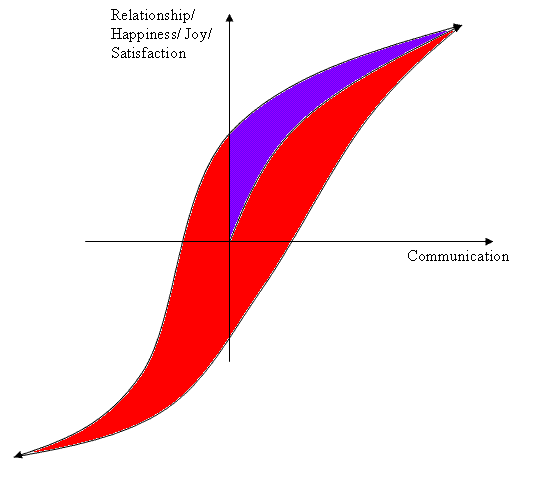
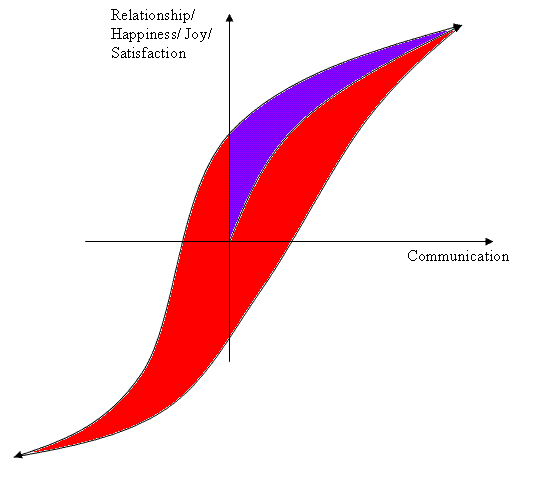
Another basic is that "relationships are built upon the foundations of good communication". That is the reason, when newly engaged couples talk for hours on phone, it makes all the sense - they want to build their relationship by communicating more and more. So, the two axis of the hysterisis loop are "happiness / satisfaction/ joy in a relationship" and "communication".
However, there is an important difference in a normal magnet's hysterisis loop and the loop drawn below.
Now, how to understand this loop. As a normal magnetic material, the relationship starts with communication and increases with more communication.
This keeps on increasing and the relationship keeps on getting deeper and more intimate.
A stage comes when views are exchanged very effectively even without speaking a word. One can continue to grow this communication and increase the joy of one's relationships.
When one stops to communicate more - a natural down-curve is followed. However, in a natural scenario, the relationships falls along the upper (enclosing the lavender area) line.
This curve is very natural. It happens in all relationships. Success of a relationship lies in pulling it up, from wherever it has fallen to. To define new origins. To introduce the relationshiop onto a still another hysterisis growth line - like the central line - separating red and lavender areas. This way, by defining new growth curves, new origins in your relationships, you continue to live happily ever-after.
Now comes the dangerous case, if communication lines are broken unnaturally - as the result of an altercation or argument etc., the relationship falls according to the lower line (enclosing the red region). This is completely avoidable.
Important thing to notice is that if the communication is brought to ZERO through unnatural means, then the relationship is more painful that joyful (intersection on "Joy" parameter when "communication"=ZERO is negative). However, if natural separation with a friend occurs, which brings down your communication, you will still be at a positive level in your relationship.
So, the gyan, NEVER close channels of communication with your partner.
Now the next level of "gyan". What is "negative" axis on communication? Negative axis on communication implies that you are getting information about your partner, through third-person. This is a very DANGEROUS situation again. While for some time, the relationship will not be impacted, this is also red region, since the trend is not good.
Don't depend on a third-person to define your relationship with someone. It will only take your relationship further down. Trust your friend, your partner, your spouse. Open newer and newer channels of communication, but DON'T let the communication axis touch the negative side of the curve.
Now, stopping to weigh you down any further... I will close on this first post.
Subscribe to:
Posts (Atom)