Sunday, April 09, 2006

The Mandal II and huge uproar

A few days back the government announced that centrally funded educational institutions like IITs, IIMs, AIIMS, JIPMER etc. should also have reservation for OBCs based on the guidelines of Mandal commission. This would take the total number of reserved seats in these insitutions to a whooping 49%. This when the population that is meant to avail this setup is about 5-10% of total Indian population.

There is at once a "huge" hue-and-cry in all parts of the country regarding this additional reservation - and that too in education system. This is largely because the present reservation system is misused. It has been misused for the past 30-40 years. To add more number of the already scarce resource (the seats) to this misuse is clearly unacceptable.

There are protests asking removal of all reservations. And there are protests that reservations, if any, should only be based on economic status. And there is also discontent amongst those who can avail these reservations that only the creamy layer amongst the caste get the benefits of these reservations and they are left behind.

So, the issue is not as simple as saying that all reservations should be abolished or that reservation should not be based on caste.

Though the present reservation system has outlived its utility, it doesn't mean that there should be no reservation. There clearly is a need for a reservation system - but definitely not in its present avatar.

The present system of reservation based solely on caste, tribe etc. should either be abolished or checks-and-balances introduced in it to prevent the flagrant misuse that is happening these days. These checks-and-balances should be put into any reservation system that is put in place.

I can think of a few checks-and-balances. Am trying to list some of them (in context of Mandal-II - related to admission to educational institutions) below:

All checks-and -balances should be reviewed by an expert committee every 5 or 10 years. The committee should include representatives of government, of non-government organizations, from different strata of society and also eminent social persons who have been working in the community for a minimum of 10-20 years etc.

  • At the time of this regular review, there should be an advertisement in all major newspapers (public notice) asking people to comment on lacunae that they see in the system. The committee should tweak the system based on these inputs.
  • In the event that this committee does not submit its review comments (including responses to a public advertisement for response on the topic) within the stipulated time, then the reservation in all categories should be reduced to 70% of total amount and only based on economic class kept at same levels.
  • The committee should also continuously review different quotas and either scrap them or replace them with more relevant quotas (if needed). In an ideal situation, the need for reservation would gradually disappear and the reservations would be phased out over time.

Any person should be eligible for reservation only if the following criteria are met
- no one from the immediate family (clearly includes siblings/ parents/ chachas/ mamas/ grandparents/ great-grand-parents etc.) has earlier availed benefits of reservation

  • this will prevent people who have already benefited from the system to not to misuse it. Like children of a government employee who has been recruited on the basis of reservation should not get any such reservation benefits.
  • This limitation should be put on the basis of grade of employment in the service. A person hired at the level of a school peon may still need to avail this reservation, but not one who is enjoying the benefits of an IAS office.

The candidate has to qualify a subject-independent (analytical/ logical skills based) test

  • This will ensure that people who can "live" with the system (say IIT system or IIM system) enter it.
  • This will prevent mishaps like - children committing suicide or being unable to complete the course even in extended duration (6 years in place of 4 years). Such a person, who has entered the system on basis of reservation is in fact destroyed by this reservation. So, a qualification test is mandatory.

There should be a system to give fees concessions and/ or soft educational loans (independent of reservations - but definitely to the benefit of those who avail reservations).

  • the concessions (either in terms of fees or softer interest rates) should be valid only for those who volunteer to take up a job in a rural area (or such parts that need development) in the first few years of his/her career.
  • in an event that the candidate does not volunteer, he/she would need to pay the current rate of fees and should be levied interest at a rate equal to (or higher) than market. The funds generated from such individuals would provide cross-subsidy for those who volunteered.

The positions left vacant - because less number of students qualified the minimum threshold - should not be filled by people who are not eligible for reservations.

  • This will ensure that people who can't avail reservation don't influence the minimum threshold.
  • As a side-effect, this will only improve the quality of education in the institute further because of improved student-teacher ratio.
  • The improved student-teacher ratio will also improve the chances of those who joined the institute on the basis of qualification aptitude test get more attention for subjects in which they were weaker than the rest of the class.

But I started this discussion by saying that some kind of reservation is definitely needed. Why do I say so?

  • Because, I have had class-mates coming from such far flung areas where electricity was only a 2-3 hours affair a day.
  • Because, I know that I was lucky to get into IIT Delhi because I could afford the fees of IIT coaching classes. There are many with more aptitude who could not make it because they did not have the financial condition to take such coachings.
    - the present system in which people can appear only once and will be selected based on aptitude test will help in ironing out this discrepancy. But this is the plan only for IITs, what about other engineering colleges and medical institutes.
  • Because, people who have been at the other end of the development initiatives need special treatment
    - like outsees from Tehri dam site, or Narmada valley, or millions who will be displaced if interlinking of rivers kind of project takes off
    - people whose lives have been completely uprooted, whose livelihoods have been impacted- for the sake of many others who benefit from the irrigation facilities or from the electricity
    - these people are as good as victims of war or terrorism for whom reservations exist. These people sacrificed their lives/ livelihoods and most importantly their cultural identity for the development of the country. We should respect their sacrifice.
  • Because, even today, there is no secondary school in a area of 5-10 km in thousands of villages.
    - Even where there are schools, the present secondary education system fails the students and drop-out rates are very high.
    - If someone persists to study in such a scenario, we have to respect the person for his determination and persistence.
    - Such people can make a positive difference to the society because they have found success the hard way and will work towards improvement of conditions for others. Our president is a very good example of such individuals.
  • Because, we have to give due respect to our soldiers and appreciate their sacrifices for the country.
    - Soldiers who spend a majority of formative years of their children away from home - on duty- fighting for the country - are not able to spend time with their children
    - Growth of children of such soldiers may experience many different kinds of pressures which impact their studies
    - Such children should be given special treatment

Having explained a bit about why I think reservation system is needed in an unequal society like ours, let me move on to think out loud on the kind of reservations that should be sufficient.

  • Total reservation in any educational institution should not exceed 40%
  • All reservations should be subject to checks-and-balances describe above
  • All the reservation quotas should be declared at the time of registration - this is sacrosanct and can't be modified for the given exam.
  • In all the categories/ sub-categories of reservations described below, 35% of reservation should be for candidates who studied from 9th to 12th standard in a rural area
  • Candidates availing this rural area benefit have to commit to take up first job in a rural area (either with government or NGOs or self-employed) for at least 2 years.
  • A candidate can be considered in at-most one of the categories of the reservations described below (except if specifically mentioned in the reservation description).
  • A candidate should have the option to not be considered for reservation - at the time of filling the registration form.
    - this should be valid even if a candidate is appearing from rural region (that is he may decide to be considered for a type of quota - but not the rural region quota under it)
  • Qualifying criteria (in the aptitude exam) should be different for candidates appearing from rural areas
    - candidates appearing from rural areas may not have enough exposure and hence may not at once be comfortable with the IQ exam that is posed to them

The categories of reservations (including sub-categories) are defined below:

  • Reservation for SC/ ST/ OBC etc. based on caste/ creed etc.
    - this reservation should be upto 50% of total quota
  • Reservation based on financial condition of the family
    - this reservation should be upto 30% of total quota
    - all other categories of reserved can also be considered under this quota
    - only this quota can be increased if none (or one) of the state dependent quotas don't exist - such that total reserved seats are at most 40% of total
  • Reservation for physically handicapped candidates
    - valid only if the handicap does not impact the effectiveness of the candidate in the desired career option
    - this reservation should be upto 2% of total quota
  • Reservation for children of soldiers who died on duty
    - this quota is valid only if the soldier died fighting (and not in an accident etc.)
    - this reservation should be upto 3% of total quota
    - this can be at all educational institutions
  • Reservation for children of soldiers who spent at least 7 years (after birth of child) in the field - on fighting duty (not office job).
    - this reservation is only valid at state level - but in both states - where the person is posted and also the state where person belongs to
    - candidates that qualify the previous point (regarding soldier died on duty) should also be additionally considered in this quota if they belong to the given state (or if the child qualified the 12th class examination from the given state)
    - this reservation should be upto 5%
  • Reservation for communities that have been impacted by displacement due to development projects but have not been satisfactorily rehabilitated - based on standard international guidelines and as directed by an national level expert committee (defined above in the checks-and-balances section)
    - this reservation is again valid only at state level
    - this reservation can be upto 3% of total reservation for each location where displacement has occured

I am not an expert on reservation quotas that exist today, and therefore I might have missed a kind of reservation that is very valid. It is for that that I have left a margin of upto 8%. This margin is more if a state has a good record of social rehabilitation and less if the state has a bad history. If I have not missed any critical reservation , then this can be added to economically backward reservation quota described in above.

Looking forward to your inputs on this.

Monday, March 27, 2006

Evolution and Rang De Basanti...

26th Jan 1950 was the day when India became a republic. The day is celebrated as a national holiday since then. Rang De Basanti was released the same day this year. It is a about a revolution. It is about the importance of having Bhagat Singh and Chandrashekhar Azad even today - today when India is already free from foriegn rule. But they are needed equally badly today because even today there is injustice and the poor (and their lives) are sacrificed on the altar of luxuries of the rich (and their consumptive desires).

What the British did to Indians then, Indians are doing to themselves these days. Injustice abounds. Government turns a deaf ear to people's calls for justice. Judiciary goes blind even in the face of stark evidence. It is in this context that we need people like Chandrashekhar Azad and Bhagat Singh even today.

The movie was released more than 2 months back, then why am I writing about it today. Because much water has flown down the Yamuna in the past 2 months. There has been an unprecedented response to injustice that was meted out in Jessica Lal murder case. Jessica Lal was a middle-class upcoming model. She was bar-tending at a Page-3 party one evening, when a group of roitous young men asked her for some drinks. She obliged. But when they came again, it was past the party-time and they were closing. She politely refused. They insisted. She was stern. Then one of the boys - son of a high-fi government official - allegedly pulled out his revolver and shot her in the head. She died even before reaching the hospital. Tens of people must have seen this. It was national headlines the next few days. But, seven years after the incident, the accussed were declared not-guilty. The judge says, "I know that you did it, but the investigating agency has not provided enough evidence". Strange...

The injustice struck a chord with the people. They had seen Rang De Basanti just a few days back. They felt that they can do something. They protested against the judgement. SMSes were recieved from far and wide. People from all over the place wrote against the injustice. Media flared up the issue far and wide.

It was strange. After a really long time was the middle class shouting. They had always been the quiet class. They recieved all the goodies - though not much in terms of "luxuries", but still a very good deal in terms of what they spent and what they got.

The poor were shouting from help, but it was rare that someone from the middle class would stop and listen to the problem and work for a solution. Or show solidarity with the poor and say that they deserved more. The middle class was never bothered about what was happening anywhere else. It was not content within itself either. It would ask for more freebies from the government - subsidies on Petrol and LPG, cheap ration, free water, cheap electricity, better roads, better TV stations and what not. But it never shouted.

That millions of people in thousands of villages do not even get clean drinking water did not bother them. They had their taps running. They used (and still use) the drinking water to wash their cars. Millions of Indians have been displaced to give electricity, minerals, water and food to this so called middle class - its actually less than 5-10% of Indian population.

But middle class had come out on the streets this time - since they felt the pain of injustice - possibly for the first time in many years...

I was hopeful that this awakening would continue. That having felt the pain of being meted out injustice, this set of influential people will possibly raise their voice whenever they see injustice. I was wrong.

On 8th March, Narmada Control Authority (NCA) cleared the decks for raising the hieght of Sardar Sarovar Project dam to 121.92 m from the present 110.2 m. They said that rehabilitation has been completed upto this hieght. It came as a shock to the villagers who were yet to be given any land. 35,000 families is not a small number. It counts to more than 1 lakh people even if you consider 3 members per family.

Jessica Lal was just 1 person. She was killed in a party attended by a limited few. The middle class had still believed the story and arose to ask for justice.

Here were more than 1 lac people, who were being murdered in broad-daylight - for everyone to see - but no one came for help.

Jessica Lal did not have even an organization giving out the details of the event, for Narmada hundreds of organizations across the world are asking for Justice (check out
http://petitions.aidindia.org/narmada/), but the middle class is unperturped. The PMO is silent. The President doesn't seem to care. The state governments are lying in the face of evidence. The people are suffering. But the middle class is sleeping.

But this was not why I started writing this article. I was triggered by another event.

Union Carbide plant in Bhopal leaked "unquantified" amounts of Methyl Iso-cyanide in air on the night of December 3, 1984. This was more than 21 years back. Thousands of people died on that night. Mass burials followed. A few survived. But their survival was difficult than death. They were suffering from disorders unknown to mankind. Union Carbide fled the country. It valued every life to about USD500. It gave the compensation to the government (not to the affected people) and fled.

The government did not ask for more. The government did not evaluate the damage caused. It simply took the money. It gave a few thousand rupees to the affected people. It kept the rest with itself - to develop Bhopal. The money was meant for survivors and affected families of the Gas Disaster. It was not a tax that someone had paid - to be used at the whims and fancies of some Babus sitting in air-conditioned offices in Delhi.

The people were suffering. Their problems have not yet been diagnosed. They still encounter births with congenital disorders at a much higher frequency than any general population would. More than one generation have been affected.

The disaster is counted as the world's worst industrial disaster. One would imagine that government would give them some special services - like Japan government did to the survivors of the nuclear bombings. But these people don't even get clean drinking water.

The tube-wells in the area, have all been contaminated by chemicals from the factory. The chemicals that Union Carbide had left in the open - and fled - had leached into the underground aquefiers. The Supreme Court had directed the government to provide clean drinking water to the affected localities. Even two years after the order, and one and a half years after the Supreme Court directive, they did not get drinking water.

In desperation, the survivors walked from Bhopal to Delhi - a distance of 800 km (http://bhopal.aidindia.org). The middle class people in Delhi are afraid to walk even 8 km in the scorching sun. But they did not feel the pain.

I went to show solidarity with the marching people in the last leg of about 6-8 km. It was a pity. The marchers - who had walked 800 km - were being treated as cattle by the police. They did not even get water on the way to Jantar Mantar (from Nizamuddin).

But they continued to walk. I continued to learn. I learnt that their resolve was strong. I learnt that they still forgave the police-wallahs. I learnt that even though they did not get any drinking water by the sides of the roads, they still liked Delhi - not for its people - but for the beautiful roads.

I also learnt that they did not see what I saw - that while crores were spent in beautifying roads in Delhi, even if a small percentage of this amount was routed to the gas affected families in Bhopal, they would not have needed to walk 800 km to Delhi.

But there was more learning to come.

I reached home after the march. I was not very tired. I am used to walking. 8km was not a long distance for me. I was definitely overwhelmed. I was excited about meeting Rashida di and Champa didi and Satinath Sarangi and Rachna and many others who had walked the distance and were ready to go on fast from the next day on. I was humbled by their resolve.

A few comments/ questions came my way. "Did you accomplish anything by wasting a day there?" "Shouldn't you rather contribute to the success of the country by working harder at office - working for something you are skilled at?" "Don't you think that a person could be hired at Rs.60/- a day to increase the crowd there?" "Did you not waste your day?"


I chose not to answer the questions - lest a fight ensue. But yes, I learnt more that evening. I realized that the effect of Rang De Basanti was not as real as I had hoped it would be.

I wondered that if I had gone for the candle light vigil in Jessica Lal case, would my family have responded similarly. Or would they have proudly claimed to their friends that I was there. I am not sure. I think they would not have resisted my participation there.

In fact, so strong is the feeling against my fighting for these causes that even when I went to Dharamsala - on a completely personal excursion/ adventure trip - I recieved a comment from one in the family "I thought you went there to light some candles on the road." The satire and sarcasm in the voice hit me hard. But then you have to learn to live with it.

Rang De Basanti possibly did not bring about an evolution in the middle class after-all...

Thursday, March 09, 2006

Equal Opportunity Employer (and Gender)

It is a kind of a fashion statement for organizations to claim that they are equal opportunity employers. What does "equal opportunity employer" imply? To me, it implies that they give equal opportunities to people with equal caliber, independent of sex, caste, creed, sexual orientation, economic status and so on - at the time or recruitment. It also means that they are fair in their dealings with all employees - after recruitment - and base their decisions without any consideration of gender, caste etc., but go for results based promotions and incentives.

I was talking to a female colleague recently. The conversation drifted to gender equality in work places. And then I realized that there is more to equal opportunity, at least in context of gender, at work places than what seems obvious. Definitely more than what was described above.

This takes us to a very relevant question - does "equal opportunity" mean visibly equal opportunities - like both men and women getting similar salaries for same kind of work, equal growth prospects in the organization etc.? Or does "equal opportunity" actually mean unequal visible opportunities - targeted to decimate physical and social differences?

I don't know the answer. I know the needs. And, I mostly speak of the knowledge based work-force here - and that too in a patriarchal society like India. That is because of my limitation of having worked only in this kind of organizations. And I do not claim to be correct. But I am free to voice a concern.

Physically, women have to bear more - independent of the society or country they are in.

Just as an example, carrying a child is something that puts a huge burden on the women - physically, emotionally and also socially. For men, at least the physical burden of this responsibility is clearly less. Most organizations (knowledge-based) do recognize the physical burden. Therefore, women get a special maternity leave - of at least a month (based on employment status) to upto 4.5 months. This is good. At least when the child is born healthy.

But what happens if there is a complexity in the pregnancy? Quite a few of my colleagues have been advised bed-rest or less stressful work-hours during pregnancy. This might be due to long working hours (around 8-9 hours, including lunch) during which the women can't take physical rest. This may also be due to stressful (at least mentally) jobs that knowledge-based corporates usually offer. So, this is a relatively common phenomenon in intelligent, modern work-force. However, there is no respite in this situation. Organizations usually don't offer such long leaves (which may extend upto 9-11 months - based on the stage in which pregnancy complications arise).

What happens if she suffers a miscarriage? While some organizations may offer the employee to go on maternity leave, others may treat it as any other medical condition. Those who offer maternity leave - cut it out of the total allowance of 2 maternity leave incidences. Those who treat it as any other medical condition are unfair because of two reasons. First, men never suffer it - so it can not be treated as any other medical condition that any employee can suffer. Second, the condition extends beyond the physical realm to emotional and social realm also. Therefore, some flexibility should definitely be offered to the person who suffers this loss.

Are organizations wrong in doing so?
Possibly not. Businesses exist to make profit. If they don't put such conditions or limitations - then in the equal wages concept of "equal opportunity employment" - they see female employees taking away more than the fair share. Because, while on leave, employees are on the rolls of the organization (and therefore get benefits -even if no salary) - but no work gets done.

The burden of being a equal opportunity employer - in the present meaning of the term - does not let the organization to pass on this loss of business interest to the women. Therefore, in its (and the share-holders) supreme business interest, an organization needs to put such limitations, or prefer to not hire female employees.

Not hiring female employees is definitely detrimental to interests of the organization. So, it doesn't get any share of the slice of "equal opportunity employer" pie. And therefore it loses in terms of business esteem and integrity. Therefore organizations prefer to put limitations on leaves that employees can take.


But what does putting such limitations do to the life of women. Most of them end up deciding to choose between career or family. They can't continue working (if they want to give higher priority to family - which is an expectation in patriarchal society like India) simply because their jobs are not flexible enough.

The problem gains higher significance because incidences of miscarriages and complexities in pregnancies are increasing - esp. in the knowledge based work-force. This is not only because of the stressful jobs and the need to sit in a place during the working hours, but also because of an attempt on the part of women to keep going to office - despite physical discomfort - to save some more leaves for post-delivery needs.

I understand that we have been asked to believe that men and women are equals. They should be treated equally. I fear that in this quest for equality (in the face of real physical and emotional differences), we may have ended up making the field more skewed against women - at least in the knowledge based industry. The present concept of equal wages poses limitations and therefore something needs to be done.

A logical suggestion to this end would be - allow women more leaves (when they need them) even if at the cost of pay. This will at least ensure that the women retain their financial independence and that the basic needs of the child are met. While this will not compromise on the business interests of the organization it will also be beneficial for the female employees.

But there is more in it for the organization than what I mentioned above (and things are not as simple). When an organization offers more leaves (even if non-paid) to its employees, then they are in a complex situation. They had that employee in the team because that person was doing some critical work. Now, this person is away on a long leave. Even though the leave may not be paid (and therefore not a direct financial burden on the organization), it does mean that some job function in the organization suffers. To avoid this, the organization will have to bring in a new member. But what happens to this new employee when the old employee returns?

Knowledge based organizations spend a lot of time and effort (and also finances) in training people for their respective job-functions. If the new employee is to be hired on an ad-hoc basis for 3-4 months, then he/she would not add any much value to the organization anyways - for by the time he/she understands the system and working methodologies in the work-place, it would be time to move on. So, what do organizations do? To prevent the business from getting impacted, the organization may decide to hire some additional employees to fill in for the employees missing on account of leave (paid or non-paid).

Redundancy in the work-force is also not a lucrative solution because typically employees needing long leaves will be at different job functions. So, even though at a time 2-4% of the work-force would need such extended leaves, the organization will end up supporting at least 10% additional work-force. So, this again is a financial burden on the organization.

However, this is exactly where the concept of "corporate social responsibility" and the claim of "equal opportunity" comes in.

Women should have a more flexible work-space. For the years/ months when the women need more flexibility (in terms of more leaves), they may ask and be paid less than their male counter-parts for the additional leaves. They should still be considered for any salary increments (that other employees are due for) and promotions. When they decide, they can ask to switch back to the normal mode and therefore, same number of leaves as male counterparts and equal salaries. It would be great if this facility is extended to all employees (and not just females).

But the secondary financial burden (like cost of special arrangements or redundancy in work-force) should not be passed on to the employees. This is where the company will be making its contribution to undo the differences that either nature or society have introduced into the life-styles. It is after this that an organization should claim to be an equal opportunity employer. Just giving equal salaries for equal work should not qualify an employer as "equal opportunity" employer - but simply a "fair" employer

While this is one aspect of providing equal opportunities to all employees (and may be valid almost anywhere), there is another dimension to equal opportunity that organizations have to ensure.

To be able to grow like their male colleagues in the organization, females may want to work late in the office (just like their male counterparts). So, to be an equal opportunity employer, the employer has to ensure that it is equally easy for female employees also to work late. But in a place (say, like Delhi) where safety and security of females is clearly a concern, the organization will need to take specific actions to ensure safety of the female employees. These actions may not be extended to males (if the financial cost of providing it to all employees is a concern), but are definitely needed for the females.

This additional effort will ensure that females really get equal opportunities to grow in the organization, despite inequities in the society. But this also means that women will end up introducing higher financial burden on the organization.


More such gender specific needs exist - esp. in a society like India, where expectations from the women - to contribute to the family - are high and the disparities in the society against the women are big. And each of these needs may require the organization to make special efforts to make the work space as equal for women as for men.

All these efforts should come under the ambit of Corporate Social Responsibility and should be counted to give the organization a title of "equal opportunity employer".

So, many organizations that claim to be equal opportunity employers may not really be. I say so, because to be an equal opportunity employer - visibly different policies for male and female employees are needed. It is only then that an employer will be able to provide equal opportunities to men and women.

So, am I professing different salaries for male and females even in a knowledge based work-space? Yes, as a choice and for a limited period of time. And I am also professing more responsibility on the part of the organization (as part of CSR) to ensure that the work space is equal for all people.

But, is this concept of lesser salaries not retrograde? No - because this "lesser" salary is applicable only in the years when the women need the flexibility. And more importantly because I am also seeking to change the job structure to suit women more - and therefore give them "really" equal opportunities to grow without compromising on the responsibilities of the family - at least as they exist in a patriarchal society.

And, what are the checks and balances? Won't this system be misused? During my discussions with quite a few people I realized that this system - though noble in thought - can be misused by both the employer and also the employee. Therefore an elaborate check-and-balance system has to be put in place. It can be in the form of having a 'special needs cell' that has members from all departments and levels in an organization. This cell would meet as and when they recieve a request for "switching ON or OFF" the special mode of employment. They would consider every case objectively - understand the need in terms of medical reports or condition of the employee - and approve. There can also be an additional ceiling that at a time, 1-2% of work-force can be in this special mode. This should be more than sufficient because normal pregnancies will be in normal operation mode and will go on regular maternity leave. But having this mode as an option will enable special cases - which are not an ignorable number either - to be able to contribute to the organization at the best possible level.

Wednesday, February 22, 2006

Prayers

When one prays, what should one ask for?
Should one ask for anything at all?

Its an interesting question that popped up in my mind some time back. I don't think that I have an answer. Can one have it?

Because, if you ask for Moksh, even then there is desire. That desire will not let you reach the goal.
Also, does it make a difference what we are asking from "a" God. I mean, Hindu pantheon has thousands of representations of God. Who should you ask for one kind of thing? Who should you ask for - say justice - and who for forgiveness? Is it right to say that Shiv ji manifests the energy of guileless forgiveness and Kali ma represents the energy of fighting for justice and equality? Is it right to say that Hanuman ji represents the ability to respect and love someone - to serve someone - without any expectation of a return? So, if we are unable to muster enough courage or energy or selflessness to serve someone (be it our parents or our boss at office), would it be the right thing to pray to Hanuman ji.

As far as I understand, hundreds of different manifestations of God in the Hindu pantheon has essentially been done so that we (the devotees) find it easier to focus our attention on one kind of energy at a time - the one that helps us overcome the deficiencies that we ourselves have. So, when you don't have the spine to fight back injustice, pray to Kali ma to give you strength to fight it out and destroy the perpetrator or to Ram ji to help you follow the path of love and resort to violence as the last resort or to Krishan ji to give you tact and also skills to defeat all the different attempts of injustice on you.

So, does that mean that we don't have an Isht dev - a God who we should pray to at all times. I don't think that this interpretation of the above text is complete. I consider this as something like "crystal therapy". In crystal therapy, one is advised to wear crystals that will compensate for missing energy from your aura body. Like if you get angry often, you essentially are short of energy that brings in patience. So, you are advised to wear a pearl. So, continuing the same line of thought, it may happen that our intrinsic nature is say that of not being able to forgive someone who did something wrong with us. In this case, having Shiv ji as your Isht dev will help you get energies of forgiveness and guileless love.

However, as anyone would understand, it doesn't happen automatically - or mechanically. That you pray to Shiv ji and you start forgiving people. It is equally important that we understand why we are praying to Shiv ji. OR, what aspect of this energy conglomerate is the most critical for our success. Once we change our focus accordingly, the deficiency of that kind of energy will be compensated.

So, this essentially brings us down to the first question again. Should we ask for anything when we pray to God? The answer is tricky. If one aspires for "Godliness", then just remembering the desired Godly form should be good enough to bring in the Godliness in oneself. In this aspect, the meditating posture of any God ji - Krishan ji in Yogavtar roop, or Shiv ji - meditating or Guru Nanak ji meditating - will bring about that transformation (gradually) in whoever puts his/her thought on that manifestation of Godliness.

If someone associates Godliness with the ability to guile-lessly forgive one and all, then Shiv ji in Nilkanth roop will bring the ability to not get impacted by negativity of any person that we are dealing with - and therefore forgive that person.

So, the idea is, that one should not exactly ask for blessings, but meditate on that manifestation of the Divine force that will help us succeed in our goals. Success will follow.

Just a thought...

Saturday, February 11, 2006

Fly-overs - and their role in "one" world

"Fly-overs are a sign of development." I can not possibly count the number of times people have praised the fly-overs to me.

In fact, I myself have praised the fly-overs in the same vein so many times.

A recent comment, though very innocuous, set me thinking. It was in context of a new fly-over planned in Delhi. "With this new fly-over, traffic will completely bypass the congested slum areas." Very promising indeed. So, we will zoom past the dark under-belly of this huge city without getting disturbed by slum children playing on the streets or pedestrians making way to their livelihood.

This is what fly-overs do. Almost all of them. They by-pass the underdeveloped parts of the city to ease the life for those living in better-off areas. So, that those with fast moving vehicles don't get bothered by pedestrians and rickshaw-pullers.

The people in those fast moving vehicles therefore ignore the presence/ absence of the people on foot. They help the rich forget the poor. They essentially divert the attention of the rich from the poor to the rich and richer.

This is possibly where the unsatiable desire to earn more and become richer than the richest starts to take birth. This is possibly where the government officers and decision makers, who move in cars - air-conditioned or otherwise, loose the sense of reality. This is possibly where the decision to make a new fly-over is taken. This is possibly where, greed metamorphoses into need. This is possibly where the "one" world gets divided.

Government of Delhi spends hundreds of crores of rupees in building these fly-overs. The need for these fly-overs arose because there was a need to speed up the traffic. It was possibly the definition of traffic that was wrong. Traffic is not just cars and scooters and SUVs. Traffic is also pedestrians and rickshaw pullers and those who need to travel by public transport to get to work.

The government should provide for speeding up the second traffic. The first one will automatically gain speed. If the hundreds of crores of rupees that the government spends on building fly-overs are rather spent on beefing up the public transport system and providing facilities in the slums, then the not only will the city develop in a more holistic fashion but the problems of traffic will also get mitigated.

Building more fly-overs can be directly compared to loosening the belt to control obesity. Yes, when your waistline increases, it is necessary to loosen the belt, but that is not the solution. The solution is to control your diet, eat healthy food and to do physical exercise. Similarly, making more fly-overs in Delhi is not going to solve the problem of congestion on the city roads. Number of vehicles on the roads need to be controlled. Focus should shift to policies that improve over-all health of the city.

Reducing the numbers (examples from elsewhere that can be adapted in Indian cities)

  • Singapore has a policy according to which cars are cheap, however their registration is costly. Its an annual auction of registration plates. This makes private ownership of vehicles a not so lucrative option in addition to raising more money with the government.
  • In another country, vehicles with only odd registration numbers are allowed on the roads on 3 days of the week and even registration numbers on the other three.
  • In another country, car pools are given special preference and they have separate fast moving lanes.
  • In another city, public transport is so good (and affordable) that it saves time to go by public transport.
  • In another city, public transport is so predictable that people plan their schedules according to bus schedule.
  • In most other countries, the pedestrian ways (foot-paths) are systematically designed and are designed on priority. These ways are not only handicap friendly, but also well-lit to ensure proper safety of pedestrians. If the foot-paths are given due weight in any road widening/ construction, pedestrian traffic is automatically taken care of. What is happening in Delhi is exactly the opposite - footpaths are broken to widen the road.

Correcting the focus

The money raised from auctioning of registration numbers and saved from building fly-overs mindlessly should be spent in a manner that the underpriviliged sections of the society also develop and contribute more effectively to nation's growth. The money should be invested in many of the following things which will again help in improving traffic speed.

  • Special lanes for bicycles and rickshaws
  • Providing better hygiene and sanitation facilities in city slums (so that people don't need to defecate on footpaths - thereby making them available for pedestrians)
  • Designing disabled friendly and senior citizen friendly pedestrian ways
  • Building pedestrian over-bridges or subways for crossing roads and providing pedestrian signals at all road crossings
  • Improving public transport (buses and metro) such that people prefer to travel by public modes.
  • Have public transport operate on a publically available schedule so that uncertainity of travel by public transport is reduced
  • Have GPS installed in all public transport vehicles to monitor and provide help in case of problems
  • Cross-subsidize public transport for low-income groups and daily wagers by providing better (and lesser congested) services for those who can pay.
  • Have dedicated car-pool lanes on high-traffic routes to motivate people to travel by car-pool. Buses and public passenger carrying vehicles have the access to these lanes.

A cultural shift in drivers is also needed. Instead of "bigger vehicle has its way", the rule should change to "pedestrian gets right of way".

Its already been a long post... I will possibly post more on this topic again. But till then, give it a thought. Let fly-overs not let us fly-past the reality.

Wednesday, November 02, 2005

The fight of heart and brain

We have a great professor at IIT Delhi. His passion drives him through all ups and downs of life and his simplicity is something to be imbibed in our lives. For the sake of privacy, I will not publish his name, but those who know me and also him will be able to make it out easily.

He is one of the best professors in Electrical Engineering Department there. I think most of the EE students will easily concur with me. At least those who have had even minimal interaction with him will realize that he does not teach for a salary, he teaches because he is passionate about it. Salary is a by-product.

He does not rate you on the basis of the grade that you get in his class, he rates you on how genuine you are and if you put in the right kind of effort. You may get bad grades in his courses, but if you are the genuine kind, he will regard you highly.

When one of our friends was not able to decide on the issue of pursuing higher studies from the US, she decided to seek advice from him. His answer is the reason for this post. His answer has always helped me, and that is why I thought that I can share it with you – it may help you also.


He said, “See… Whenever you face a dilemma in life – with your brain pulling you on one side and your heart on the other – then go with what your heart says… You will be happy…”

I am not sure if you realize the depth in this statement. This had come from a person with years of experience teaching the best brains of India – asking us to neglect the brain when it fights with the heart. Its difficult for engineers to do it.


But it is surely a mantra for happiness. It will bring happiness to you – be it in a personal situation or a professional relationship.

But there is a “big” rider attached to this statement… This will hold true when you are in a “dilemma” – that is, you have been thinking about something for some time. Its not a ‘spur of the moment’ kind of situation that you can apply this statement. It is when you have given your brain and your heart an equal opportunity to analyze/ think about the situation.

So, when you are angry and want to hit someone hard – it is a ‘spur of the moment’ situation and the mantra will not help you… However, if you are thinking of a career change for say 2 months, but unable to decide if you should take the plunge in a new situation and leave the old behind, then this “mantra” holds the key to your happiness…

To me, this ‘mantra’ has always been the key to happiness and satisfaction. I see a reason behind this. We usually face a dilemma of the said type when – logically thinking – we see lesser chances of success by following our heart. However, when we work with passion – and put our heart and soul into an activity – all the obstacles in our path give way to success. Hence, we are happy…

The idea is to have such high passion that the “thoughtrons” – the energy particles of thought (positive, in this case) - completely overcome the negative energy of the obstacles that may exist on the path. And this happens – it happens every time one sets out whole-heartedly to accomplish a task.

And happiness, at all times, is not dependent on success. We need to realize that in the long run, happiness and satisfaction come from the effort that one puts in. It is not the final outcome that determines our satisfaction levels, it is the effort that we put to achieve that success.

If you taste success, you will definitely feel happy – because you got success on your terms – by following your heart. If, however, one is not able to succeed, the satisfaction of having tried ones best (remember, “with all your heart”), will tide over any sorrow of having failed to goal. Also, success might not have been assured if the brain had won the battle... In such a case, one would feel worse off for two reasons - one for failing, and the other for not even trying what one actually wanted to do.


Moreover, life is short and unpredictable. One should rather do things that one loves than those that are dictated by society or reason. If Edison would have followed reason, telephones would not have been reality. If reason persisted at all times, flying would not be possible. It is when one follows ones heart that one innovates and succeeds.

Also, the new lessons learnt on the path of heart stay longer and benefit more, than those learnt on the path of reason. There are more opportunities to grow with your heart than without it.

Think over it...


Saturday, October 01, 2005

Communication, Relationships and Magnets


All of us have relationships - with friends, with parents, with siblings, with colleagues, with lots of people around us. This mail is on "how to make your relationships joyful".

Taking this line a bit further, many of us are about to enter or will enter into relationships that have the potential of changing the course of our lives.

Non-engineering audience may feel slightly bored, but I think everyone read about these basics earlier.

Wise old men have at times compared people to magnets. We attract some people and situations, and we repel others. I am just extending upon this. And as usual, I am open to feedback and comments.

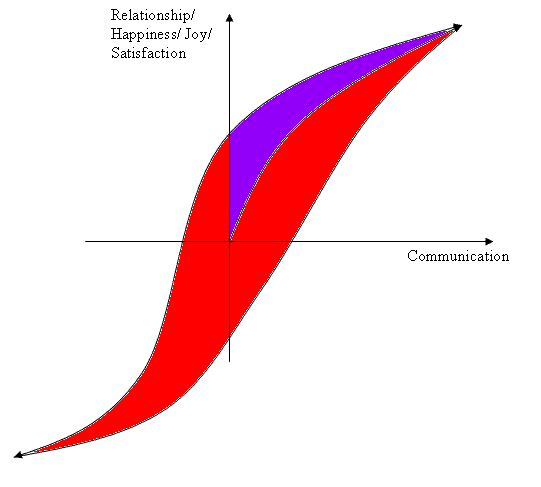
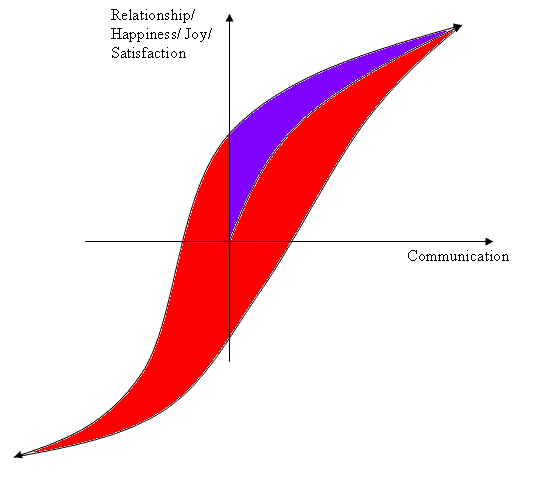
Magnetism has an associated concept of "hysterisis". This can be more easily understood as "history" or "memory". Since human beings have "memory", hysterisis can be used to explain some of our real-life situations.


Another basic is that "relationships are built upon the foundations of good communication". That is the reason, when newly engaged couples talk for hours on phone, it makes all the sense - they want to build their relationship by communicating more and more. So, the two axis of the hysterisis loop are "happiness / satisfaction/ joy in a relationship" and "communication".

However, there is an important difference in a normal magnet's hysterisis loop and the loop drawn below.

Now, how to understand this loop. As a normal magnetic material, the relationship starts with communication and increases with more communication.

This keeps on increasing and the relationship keeps on getting deeper and more intimate.

A stage comes when views are exchanged very effectively even without speaking a word. One can continue to grow this communication and increase the joy of one's relationships.

When one stops to communicate more - a natural down-curve is followed. However, in a natural scenario, the relationships falls along the upper (enclosing the lavender area) line.

This curve is very natural. It happens in all relationships. Success of a relationship lies in pulling it up, from wherever it has fallen to. To define new origins. To introduce the relationshiop onto a still another hysterisis growth line - like the central line - separating red and lavender areas. This way, by defining new growth curves, new origins in your relationships, you continue to live happily ever-after.

Now comes the dangerous case, if communication lines are broken unnaturally - as the result of an altercation or argument etc., the relationship falls according to the lower line (enclosing the red region). This is completely avoidable.

Important thing to notice is that if the communication is brought to ZERO through unnatural means, then the relationship is more painful that joyful (intersection on "Joy" parameter when "communication"=ZERO is negative). However, if natural separation with a friend occurs, which brings down your communication, you will still be at a positive level in your relationship.

So, the gyan, NEVER close channels of communication with your partner.

Now the next level of "gyan". What is "negative" axis on communication? Negative axis on communication implies that you are getting information about your partner, through third-person. This is a very DANGEROUS situation again. While for some time, the relationship will not be impacted, this is also red region, since the trend is not good.

Don't depend on a third-person to define your relationship with someone. It will only take your relationship further down. Trust your friend, your partner, your spouse. Open newer and newer channels of communication, but DON'T let the communication axis touch the negative side of the curve.

Now, stopping to weigh you down any further... I will close on this first post.